

What are the disadvantages of a segment LCD display?
Leave a message

Hey there! As a supplier of segment LCD displays, I've seen firsthand the many benefits these displays bring to various industries. They're simple, cost - effective, and widely used in things like power meters, household appliances, and devices with FPC connectors. But like anything, they're not without their drawbacks. Let's dig into the disadvantages of segment LCD displays.
Limited Display Capability
One of the most obvious downsides of segment LCD displays is their limited display capability. These displays are designed to show pre - defined segments, like numbers, simple symbols, or basic icons. You won't be able to display complex graphics, high - resolution images, or detailed text on them.
For example, if you're looking to create an interactive user interface with buttons, sliders, and detailed visualizations, a segment LCD display just won't cut it. It's like trying to paint a detailed portrait with a single - color crayon. You're restricted to the segments that are built into the display, and there's no easy way to change or expand them.
This limitation can be a real problem in industries where rich visual information is needed. In the consumer electronics market, for instance, users expect sleek, high - tech displays that can show a lot of information at once. Segment LCD displays fall short in this regard, making them less suitable for modern smartphones, tablets, or high - end smartwatches.
Poor Viewing Angles
Another major disadvantage is the poor viewing angles. Segment LCD displays typically have a narrow range of angles from which the display can be clearly seen. If you look at the display from the side or at an angle, the contrast and visibility can drop significantly.
This is due to the way the liquid crystals in the display are aligned. When viewed from the optimal angle, the light passes through the liquid crystals in the right way to create a clear image. But as you move away from this angle, the light is scattered or absorbed differently, causing the image to become dimmer and less distinct.
In a real - world scenario, this can be a hassle. Imagine using a power meter with a segment LCD display. If you're not standing directly in front of it, you might have trouble reading the numbers. Or in a household appliance, like a microwave with a segment LCD display, if you're looking at it from an angle while standing at the counter, you may not be able to see the settings clearly. You can check out our Segment LCD Display for Power Meter and Segment LCD Display for Household Appliance to get a better idea of how this issue might play out.
Slow Response Time
Segment LCD displays also have a relatively slow response time. The response time refers to how quickly the display can change from one state to another. In the case of segment LCD displays, it takes a bit of time for the liquid crystals to realign when the display needs to show a different segment or change a number.
This slow response time can be a problem in applications where fast - changing information needs to be displayed. For example, in a sports device that shows real - time speed or heart rate changes, a segment LCD display may not be able to keep up. The numbers might seem to lag behind the actual data, giving inaccurate or delayed information to the user.
In gaming or other interactive applications, the slow response time can lead to a less - than - smooth experience. You won't get that instant feedback that you'd expect from a high - end display, which can be frustrating for users.
Limited Color Options
Most segment LCD displays are monochrome, meaning they can only show one color, usually black or blue on a white background. This lack of color options can make the display look dull and unappealing.
In today's market, color is a big deal. Consumers are used to seeing bright, vibrant colors on their devices. Color can also be used to convey important information. For example, in a medical device, different colors could be used to indicate different levels of a patient's vital signs.
With segment LCD displays, this kind of color - coded information is not possible. The lack of color can also make the display less engaging. In a marketing or advertising context, a monochrome segment LCD display won't be as eye - catching as a full - color display, which can be a drawback for businesses trying to attract customers.
Temperature Sensitivity
Segment LCD displays are quite sensitive to temperature changes. Extreme temperatures can have a significant impact on their performance.

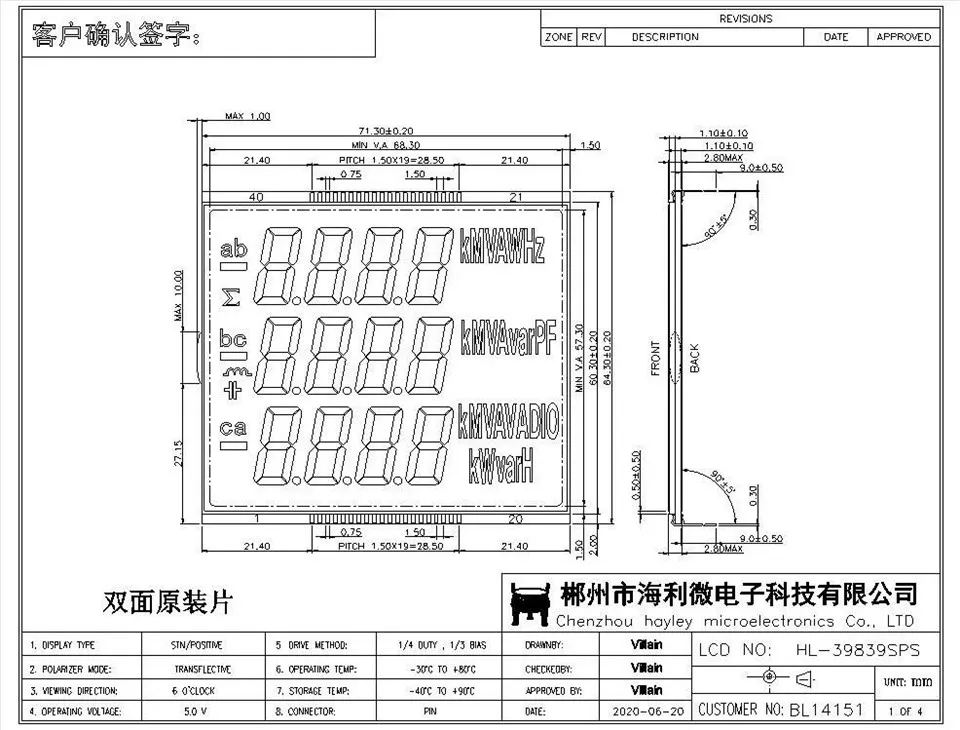
At low temperatures, the liquid crystals in the display become more viscous, which means they move more slowly. This can cause the response time to slow down even further, and in some cases, the display may not work at all. On the other hand, at high temperatures, the liquid crystals can become too fluid, leading to a loss of contrast and clarity.
In outdoor applications, this temperature sensitivity can be a real problem. For example, if a segment LCD display is used in a weather station, it may not function properly in extremely cold or hot weather. In industrial settings where the temperature can vary widely, the display's performance can also be unreliable.
Durability Issues
When it comes to durability, segment LCD displays have some issues. The liquid crystals inside the display are delicate and can be damaged easily. Physical shocks, vibrations, or pressure can cause the liquid crystals to misalign, leading to display defects.
In addition, the thin glass panels that make up the display are also prone to cracking or breaking. If the device with the segment LCD display is dropped or bumped, there's a good chance the display will be damaged.
This lack of durability can be a concern for applications where the device is likely to be subjected to rough handling. For example, in a portable power meter that may be carried around on a job site, or a household appliance that might get knocked around in the kitchen.
Dependence on Backlighting
Most segment LCD displays rely on backlighting to be visible, especially in low - light conditions. While backlighting can improve the visibility of the display, it also has its own set of problems.
First of all, backlighting consumes power. This can be a significant issue in battery - powered devices. The more powerful the backlighting, the more energy it uses, which can reduce the battery life of the device.
Secondly, the backlighting can age over time. As the backlight ages, its brightness can decrease, causing the display to become dimmer. Replacing the backlight can be a complicated and expensive process, especially in smaller devices.
Despite these disadvantages, segment LCD displays still have their place in the market. They're simple, reliable, and cost - effective for applications where the limitations mentioned above aren't a big deal. For example, in basic calculators, simple digital clocks, or some industrial control panels, segment LCD displays work just fine.
If you're considering using segment LCD displays for your products, it's important to weigh these disadvantages against the benefits. And if you have any questions or want to discuss your specific requirements, feel free to reach out for a procurement discussion. We're here to help you make the best decision for your business. You can also explore our Segment LCD Display with FPC Connector to see if it meets your needs.
References
- "Liquid Crystal Displays: Principles and Applications" by E. Kaneko
- "Handbook of Display Technology" edited by John P. Fitts


