

What is the difference between a 2.4 Inch TFT LCD Display and a reflective display?
Leave a message

Hey there, tech enthusiasts! I'm a supplier of 2.4 Inch TFT LCD Displays, and I often get asked about the differences between 2.4 Inch TFT LCD Displays and reflective displays. That's what we're gonna dig into today.
Let's start with the basics. TFT, which stands for Thin-Film Transistor, is a technology used in LCD (Liquid Crystal Display) screens. In a 2.4 Inch TFT LCD Display, each pixel has its own transistor that controls the amount of light passing through the liquid crystals. This allows for high - quality image and video display, making it a popular choice for a wide range of applications.
On the other hand, a reflective display relies on external light sources, like sunlight or ambient room light, to illuminate the screen. Instead of using a backlight like TFT LCD displays, it reflects the light that hits it to show the content.
Visual Quality
One of the most obvious differences is the visual quality. My 2.4 Inch TFT LCD Displays offer vibrant colors and high contrast. They can generate rich, vivid images because they have a built - in backlight that can shine through the liquid crystals. This is super important if you're using the display for things like watching videos, playing games, or showing graphics.

For example, if you're designing a portable media player, a 2.4 Inch TFT LCD Display will provide a great viewing experience. The movies or photos will look sharp, and the colors will pop. You can check out our other sizes too, like the 7 Inch TFT LCD Display, which is even better for larger - scale media display.
Reflective displays, however, often have more subdued colors. Since they rely on external light, the color accuracy can be affected by the quality and intensity of that light. In low - light conditions, the screen might be hard to read. But in bright sunlight, a reflective display can actually be an advantage. It won't wash out like a TFT LCD because it's using the sunlight to its advantage, making it ideal for outdoor applications.
Power Consumption
Power consumption is another big factor. 2.4 Inch TFT LCD Displays come with a backlight, and that backlight uses a fair amount of energy. If you're using a device with a TFT LCD Display for a long time, you'll notice that the battery drains relatively quickly. This might not be a problem if your device is always plugged in, but for portable devices, it can be a hassle.
For instance, if you're using a handheld device with a 2.4 Inch TFT LCD Display for several hours a day, you'll need to recharge it frequently. If power efficiency is crucial, maybe you should also take a look at our 1.44 Inch TFT LCD Display, which generally consumes less power due to its smaller size.
Reflective displays, on the other hand, are extremely power - efficient. Since they don't need a backlight, they only use power when the image on the screen changes. This makes them perfect for things like e - readers and smartwatches, where you want the device to last a long time on a single charge.
Viewing Angles
When it comes to viewing angles, 2.4 Inch TFT LCD Displays have an edge. They can usually be viewed from a wide range of angles without losing much image quality. Whether you're looking at the screen straight on or from a bit of an angle, you'll still be able to see the content clearly. This is great for sharing the screen with others or for using the device in different positions.
Reflective displays, unfortunately, have more limited viewing angles. If you're not looking at the screen straight on, the image can become distorted or hard to read. This can be a drawback if you need to show the screen to multiple people or if you use the device in various orientations.
Cost
Cost is always a consideration. Generally, 2.4 Inch TFT LCD Displays are a bit more expensive. The technology behind the TFT LCD, especially the backlight and the individual pixel transistors, adds to the production cost. But considering the high - quality display they offer, it's often worth the investment for applications where visual quality is a top priority.
Reflective displays are usually cheaper to produce. Since they don't require a backlight and have a simpler design, the manufacturing costs are lower. This makes them a more affordable option, especially for budget - conscious projects.
Applications
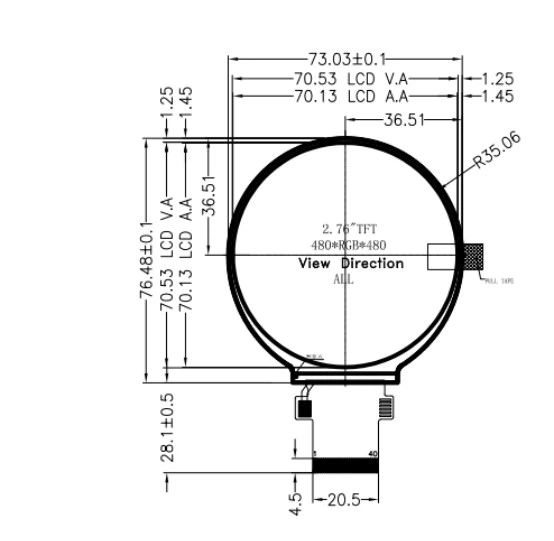
The different characteristics of these two types of displays make them suitable for different applications. My 2.4 Inch TFT LCD Displays are commonly used in smartphones, portable media players, and car dashboards. The high - quality display is essential for these applications because users need to see sharp images and videos. We also have 2.76 Inch TFT LCD Display available, which can be used in similar but slightly larger - scale device designs.
Reflective displays are often found in e - readers, calculators, and some smartwatches. Their power efficiency and ability to work well in bright light make them perfect for these devices. You don't need a super - vibrant display for reading e - books, but you do need a screen that's easy to read in sunlight and doesn't drain the battery quickly.
So, which one should you choose? It really depends on your specific needs. If you need a display with high - quality visuals, wide viewing angles, and don't mind the power consumption and cost, then a 2.4 Inch TFT LCD Display is the way to go. On the other hand, if power efficiency and outdoor readability are your top priorities, and you can live with more subdued colors and limited viewing angles, a reflective display might be better for you.
If you're interested in our 2.4 Inch TFT LCD Displays or any of our other products, don't hesitate to reach out for a procurement discussion. We're here to help you find the best display solution for your project!
References
- Smith, J. (2022). Display Technology Guide. Tech Publishing.
- Johnson, A. (2023). Choosing the Right Display for Your Device. Electronics Journal.


