

What is the response time of an STN LCD display?
Leave a message

In the realm of display technologies, STN (Super Twisted Nematic) LCD displays have long held a significant position, offering a balance between cost - effectiveness and performance. As a seasoned STN LCD display supplier, I've had numerous interactions with clients who are curious about various aspects of these displays, and one question that frequently arises is: "What is the response time of an STN LCD display?"
Understanding Response Time
Before delving into the specifics of STN LCD display response times, it's crucial to understand what response time means. In the context of displays, response time refers to the time it takes for a pixel on the screen to change from one color state to another. It is typically measured in milliseconds (ms). A lower response time implies that the display can transition between colors more rapidly, which is particularly important for applications where fast - moving images are involved, such as video playback or gaming.
Response Time of STN LCD Displays
STN LCD displays generally have a relatively slow response time compared to some other modern display technologies. On average, the response time of an STN LCD display can range from 100 ms to 500 ms. This is in contrast to more advanced display types like TN (Twisted Nematic) or IPS (In - Plane Switching) LCDs, which can have response times as low as 1 ms to 10 ms.
The slower response time of STN LCDs is mainly due to their underlying liquid crystal technology. In an STN LCD, the liquid crystals need to be twisted through a larger angle compared to other LCD types to achieve the desired optical effect. This larger twist angle requires more time for the liquid crystals to realign when an electrical signal is applied, resulting in a longer response time.
Implications of Response Time in Different Applications
Static Displays
For applications where the content on the display is mostly static, such as digital watches, calculators, or simple industrial control panels, the relatively slow response time of STN LCDs is not a major concern. In these cases, the display is primarily used to show fixed information, and there is no need for rapid color transitions. For instance, a digital watch only needs to update the time periodically, and the slow response time of an STN LCD does not affect its functionality.
Dynamic Displays
However, when it comes to applications that involve dynamic content, the slow response time of STN LCDs can be a drawback. In video playback, for example, a slow response time can lead to motion blur. When a fast - moving object is displayed on the screen, the pixels may not be able to change color quickly enough to keep up with the movement, resulting in a blurry trail behind the object. Similarly, in gaming, a slow response time can cause input lag, where there is a delay between the player's action and the corresponding change on the screen. This can significantly impact the gaming experience, especially in fast - paced games.

Improving the Response Time of STN LCDs
Although STN LCDs inherently have a slower response time, there are some techniques that can be employed to improve it to a certain extent.
Overdrive Technology
One such technique is overdrive technology. Overdrive works by applying a higher voltage to the liquid crystals during the transition period, which helps them to realign more quickly. By using overdrive, the response time of an STN LCD can be reduced by a certain percentage, although it may still not reach the levels of more advanced display technologies.
Advanced Liquid Crystal Materials
Another approach is to use advanced liquid crystal materials. Newer liquid crystal formulations can have faster switching speeds, which can lead to a shorter response time. However, these advanced materials may also come with higher costs, which can affect the overall price of the STN LCD display.
Our Offerings as an STN LCD Display Supplier
As a supplier of STN LCD displays, we understand the importance of response time in different applications. We offer a range of STN LCD displays with varying response times to meet the diverse needs of our customers.
For customers who require STN LCDs for static display applications, we provide cost - effective solutions with standard response times. These displays are designed to offer reliable performance at an affordable price.
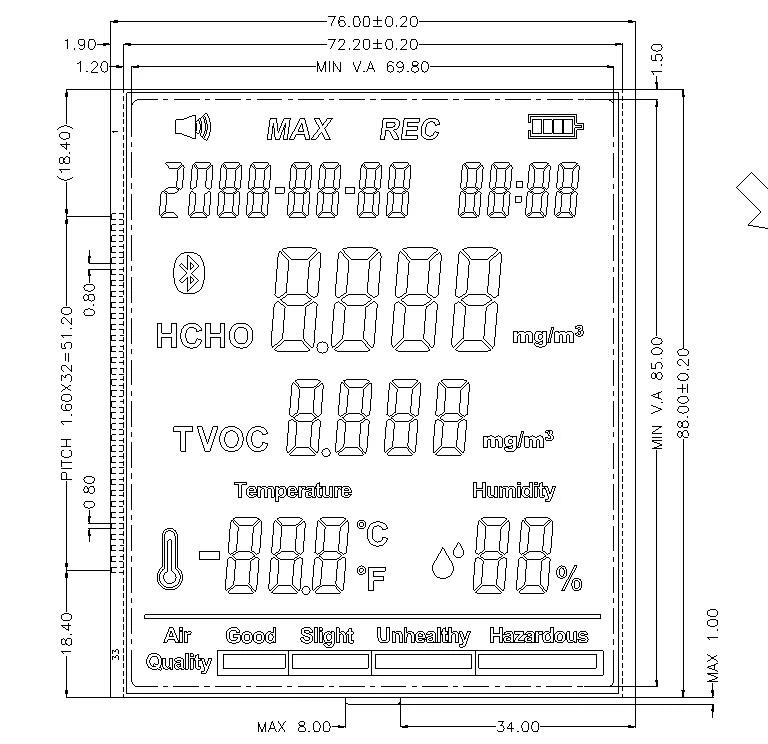
On the other hand, for customers who need STN LCDs for applications with some degree of dynamic content, we offer displays with improved response times through the use of overdrive technology. Our Positive Transmmisive STN LCD Display is one such product that combines a reasonable response time with good optical performance.
Conclusion
In conclusion, the response time of an STN LCD display is an important factor to consider when choosing a display for a particular application. While STN LCDs generally have a slower response time compared to other display technologies, they still have their place in the market, especially for static display applications.
As a supplier, we are committed to providing high - quality STN LCD displays that meet the specific requirements of our customers. Whether you need a display for a simple static application or a more demanding dynamic one, we have the expertise and products to meet your needs. If you are interested in learning more about our STN LCD displays or would like to discuss your specific requirements, we encourage you to contact us for a procurement discussion. We look forward to working with you to find the perfect display solution for your project.
References
- "Liquid Crystal Displays: Addressing Schemes and Electro - optical Effects" by Ernst Lueder
- "Fundamentals of Flat Panel Displays" by F. S. Chen


