

What is the refresh rate of a 2.4 Inch TFT LCD Display?
Leave a message

In the realm of display technology, the refresh rate is a crucial factor that significantly impacts the visual experience. As a leading supplier of 2.4 Inch TFT LCD Displays, I am often asked about the refresh rate of these displays. In this blog post, I will delve into the concept of refresh rate, explain its importance, and discuss the typical refresh rates of 2.4 Inch TFT LCD Displays.
Understanding the Refresh Rate
The refresh rate of a display refers to the number of times per second the display updates the image on the screen. It is measured in Hertz (Hz). For example, a display with a refresh rate of 60 Hz updates the image 60 times per second. A higher refresh rate means that the display can update the image more frequently, resulting in a smoother and more fluid visual experience.
To illustrate this, imagine watching a fast - moving action scene on a display. If the refresh rate is low, say 30 Hz, you may notice a phenomenon called screen tearing or stuttering. Screen tearing occurs when the display tries to show an image that is in the process of being updated, resulting in a visible split or distortion on the screen. Stuttering, on the other hand, makes the motion appear jerky and uneven. In contrast, a higher refresh rate, such as 120 Hz or more, can eliminate these issues and provide a seamless and immersive viewing experience.
Importance of Refresh Rate in 2.4 Inch TFT LCD Displays
For 2.4 Inch TFT LCD Displays, the refresh rate plays a vital role in various applications. These displays are commonly used in portable devices such as smartwatches, handheld gaming consoles, and industrial control panels.
In smartwatches, a higher refresh rate can make the user interface more responsive. When you swipe through apps, view notifications, or check the time, a smooth and fluid display can enhance the overall user experience. For example, if you are using a fitness tracking app on your smartwatch and it shows real - time data such as heart rate and steps taken, a high - refresh - rate display will ensure that the numbers update smoothly without any lag.
Handheld gaming consoles also benefit greatly from a high refresh rate. In fast - paced games, where quick reactions are required, a low refresh rate can give the player a disadvantage. A higher refresh rate allows for more accurate and timely visual feedback, making the gameplay more engaging and competitive.
In industrial control panels, a reliable and high - speed refresh rate is essential for monitoring and controlling processes. Operators need to be able to see real - time data clearly and without delay. A low refresh rate could lead to missed information or incorrect readings, which can have serious consequences in industrial settings.
Typical Refresh Rates of 2.4 Inch TFT LCD Displays
The typical refresh rate of a 2.4 Inch TFT LCD Display can vary depending on several factors, including the display's resolution, the type of driver used, and the intended application.
Most standard 2.4 Inch TFT LCD Displays have a refresh rate in the range of 60 Hz to 120 Hz. A 60 Hz refresh rate is the most common and is sufficient for many basic applications such as displaying static images, simple text, or slow - moving animations. It provides a decent visual experience and is often the default setting for cost - effective displays.
However, for more demanding applications such as gaming or high - speed data visualization, displays with higher refresh rates are available. Some high - end 2.4 Inch TFT LCD Displays can reach refresh rates of up to 120 Hz or even higher. These displays are designed to meet the needs of users who require the best possible visual performance.
It's important to note that increasing the refresh rate often comes at a cost. Higher - refresh - rate displays typically require more power to operate, which can be a concern for portable devices with limited battery life. Additionally, they may be more expensive to manufacture, which can translate into a higher price for the end - user.
Comparing with Other TFT LCD Displays
When considering the refresh rate of a 2.4 Inch TFT LCD Display, it can be helpful to compare it with other sizes of TFT LCD Displays. For example, the 2.76 Inch TFT LCD Display may have a similar range of refresh rates, but due to its larger size, it may require more power to achieve the same refresh rate.
The 2.2 Inch TFT LCD Display, on the other hand, may be more power - efficient and may have a slightly lower refresh rate in some cases, as it is designed for more compact and low - power applications.
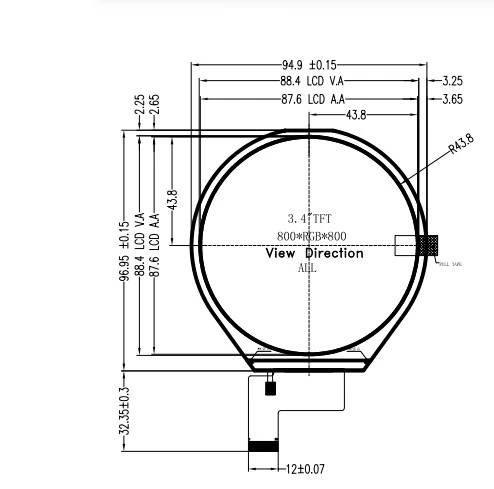
The 3.4 Inch TFT LCD Display is likely to have a wider range of refresh rate options, including higher rates for more demanding applications. Larger displays often have more advanced technology and can support higher refresh rates to provide a better visual experience.
Factors Affecting the Refresh Rate
Several factors can affect the refresh rate of a 2.4 Inch TFT LCD Display. One of the most significant factors is the display's resolution. Higher - resolution displays require more data to be transferred and processed, which can limit the refresh rate. For example, a display with a resolution of 800x480 pixels may have a lower refresh rate compared to a display with a lower resolution, such as 320x240 pixels, if the same amount of processing power is available.
The type of driver used in the display also plays a crucial role. A high - performance driver can handle data transfer more efficiently, allowing for a higher refresh rate. Additionally, the quality of the backlight and the overall design of the display can impact the refresh rate.
How to Choose the Right Refresh Rate
When choosing a 2.4 Inch TFT LCD Display, it's important to consider your specific needs and requirements. If you are using the display for basic applications such as showing static images or simple text, a 60 Hz refresh rate may be sufficient. This will save power and cost less.

However, if you are using the display for gaming, high - speed data visualization, or other demanding applications, a higher refresh rate, such as 90 Hz or 120 Hz, is recommended. This will ensure a smooth and responsive visual experience.
Contact Us for Procurement
If you are interested in purchasing 2.4 Inch TFT LCD Displays or have any questions about refresh rates and other technical specifications, please feel free to contact us. Our team of experts is ready to assist you in finding the right display for your application. We offer a wide range of 2.4 Inch TFT LCD Displays with different refresh rates, resolutions, and features to meet your specific needs.
References
- "Fundamentals of Display Technology" by John A. Robertson
- "LCD Displays: Principles and Applications" by Michael F. Tompsett


